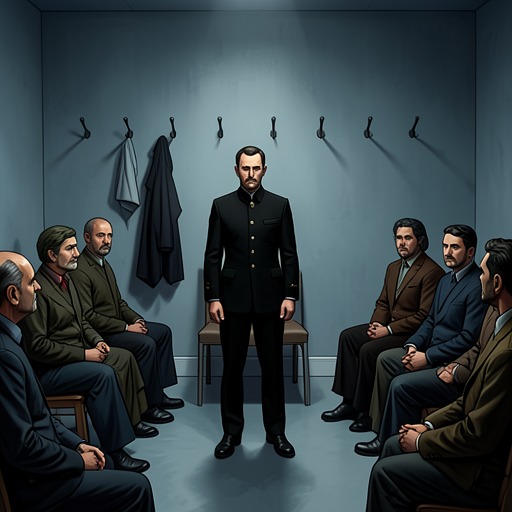
Burden of proof in criminal cases for the prosecution
Defending JacobThe prosecution’s burden of proof is the rule that the state must establish its case against the accused; the defense does not have to prove innocence or supply a substitute culprit. In Jacob Barber’s trial, that principle is stated plainly by his lawyer, Jonathan, but the case also exposes the distance between a legal standard and the stories jurors are asked to believe. The prosecution must prove guilt, yet uncertainty and the appetite for explanation make the contest over narrative difficult to avoid.
The Defense’s Procedural Position
Jonathan tells Jacob that the defense has no burden and need not present a defense at all: its task is to attack the prosecution’s case until it is no longer sufficient. He frames this as the defining allocation of responsibility in a criminal trial. The state must make its proof hold; the accused is not obliged to fill gaps in the state’s account.
Andrew Barber accepts the principle intellectually but resists its practical implications. The prosecution has a fingerprint and a witness who places a knife in Jacob’s hand, and Andrew fears that merely exposing weaknesses will not give jurors enough to make sense of the case. When Jonathan says they must play the cards dealt to them, Andrew answers that they have to find new ones. Their disagreement shows how the formal rule can coexist with a tactical anxiety that jurors will expect the defense to tell them who else committed the crime.
Proof and the Pressure of Narrative
The trial’s competing accounts turn on more than the presentation of individual facts. Neal Logiudice’s opening frames Ben Rifkin’s death as a story of a boy with a privileged life and a lethal temper who was pushed until he suddenly snapped. He presents Ben’s teasing as the trigger and casts the killing as the final act in a causal tale. The narration observes that this story is rhetorically effective even while Andrew regards Logiudice’s account as false.
The opening also reveals a tension within proof itself: motive may not be a formal element of the case, but jurors want to understand why the crime occurred. Logiudice cannot identify a definite trigger and offers possibilities instead. The absence of a clear explanation leaves an opening between the prosecution’s proposed story and what its evidence can establish; the legal burden cannot be replaced by a plausible-sounding account of motive.
Andrew, meanwhile, believes that jurors will want an alternative answer if they are asked to reject the prosecution’s theory. He plans to make Leonard Patz the defense’s counter-narrative, convinced that Patz committed the murder. Andrew later recognizes that his reasoning risks circularity: Patz’s guilt seemed to follow from Jacob’s innocence, rather than being established independently in his mind. His conviction that the counternarrative is true does not erase the distinction between a defense theory and proof.
Incomplete Evidence and Investigative Stories
The book broadens the courtroom issue into a problem of investigation. In testimony, Andrew describes how detectives facing incomplete data form a theory, search for facts that support it, and may stop noticing evidence pointing elsewhere. His example is the possibility of Leonard Patz. This account makes the burden more than a courtroom formula: the quality of the state’s eventual proof depends on whether its investigation remains open to competing explanations.
A detail from the murder story posted by Jacob on The Cutting Room complicates that contest. Andrew explains that its description of the knife wounds’ angle was not public information and was difficult to guess; he took the detail as a written confession and evidence sufficient for probable cause. The account illustrates the force of specific evidence, while the broader trial continues to ask how such evidence should be interpreted and whether it completes the state’s burden.
Closure, Verdict, and What Proof Cannot Repair
For Dan Rifkin, resolution has an intensely personal meaning. He tells Andrew that uncertainty is draining and hopes the case will be resolved, the responsible person identified, and that person locked away. His appeal shows what a prosecution is expected to provide to a bereaved family: not only a legal result but an end to uncertainty. Yet the desire for closure is not itself evidence of guilt, and the emotional need for a settled answer can sit uneasily beside the requirement that the state prove its case.
When Leonard Patz confesses and the prosecution drops the charges against Jacob, Andrew describes the outcome as more than a not-guilty verdict: to him, Jacob has been proven innocent. The distinction is emotionally decisive for the family, but the scene also emphasizes the procedure’s limits. The charges are dismissed through a nolle prosequi before the judge takes the bench; the ruling frees Jacob from the prosecution, while it cannot undo the fear, grief, and conflict produced by the case. The burden of proof protects an accused from conviction without sufficient evidence, but it does not guarantee that the process will restore the lives it has unsettled.